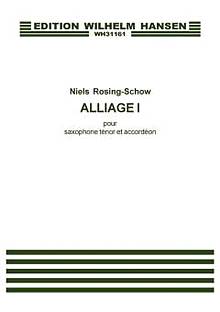
 Alliage I
Programme note: Alloy I for Tenor Saxophone and Classical Accordion. The two instuments of this duo have some common features, i.e. is the tone in both cases produced by air. The air is activated by the lungs of the saxophone player and by the bellow of the accordion. The stream of air makes a blade of respectively wood and metal vibrate. Both instruments are also associated with the popular musical tradition. But nevertheless the differences regarding the sound are more prominent than the similarities, and contrary to the monophonic saxophone (a ‚melody‘ instrument), the accordion is a polyphonic instrument, which can produce several simultanious melodic lines and chords. At first glance this might call for a music, which distributes distinct, even contrasting, musical roles to the two instruments, such as melody versus accompaniment. But I refrain from this obvious ‚casting‘, since I have always been fascinated by the less evident, by transitions and gradual displacement, by the intangible places between one and the other. I search for this ‚terrain vague‘ of fruitfull incertainty and permanent genesis. To arrive here, I have in this piece written a music, which makes the possible relations and sonorous pathscome forward between the sound worlds of the two instruments. Bringing together the musical substances, I look for an ‚air-driven‘ musical organism with a glossy and shining appearance. The lively and bright sound world I associate to alloys, in particular the silvery amalgamations of mercury. Niels Rosing-Schow
Tenorsaxophon und Akkordeon Spielpartitur(en)
Niels Rosing-Schow Gemischtes Ensemble
Verlag: Edition Wilhelm Hansen WH31161
 Birds Fragments III